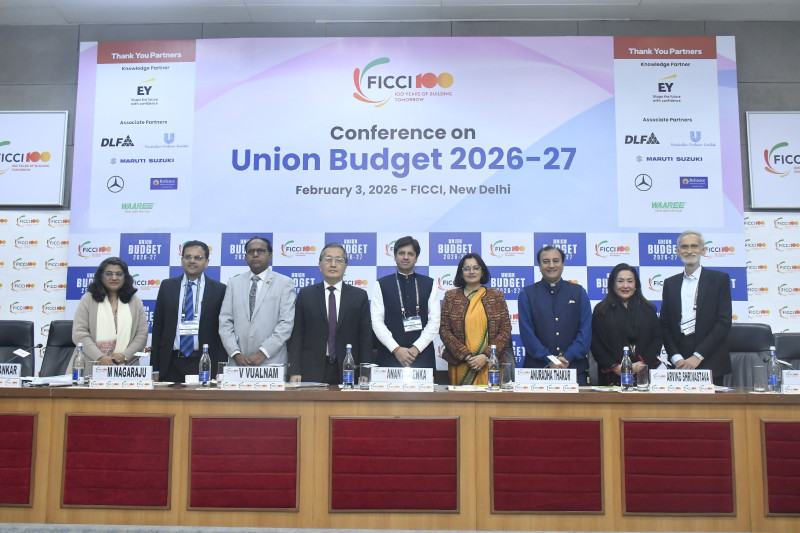
New Delhi, 3 February 2026: Union Budget 2026–27 introduces structural reforms designed to grant taxpayers greater autonomy and reduce their engagement with tax authorities, Revenue Secretary Mr Arvind Shrivastava told industry leaders at a FICCI interactive session on the Union Budget 2026-27.
Addressing senior business figures, Revenue Secretary Shrivastava said the reforms reflect the government’s conviction that taxpayers prefer compliance over disputes. “The fundamental thought behind this is that we believe the general incentive with the taxpayer is to be honest, would rather like to pay his tax dues as long as he can appreciate those to be legitimate,” he said.
The budget extends the return filing revision period by three months and permits updated returns for four years. Even where assessment proceedings have commenced, taxpayers may now submit updated returns that will form the basis for examination. Since the updated returns window opened, 1.22 crore taxpayers have voluntarily corrected their filings, generating ₹13,500 crore in additional revenue.
On indirect taxation, the government is expanding benefits under the Authorised Economic Operator scheme and shifting customs oversight from transaction-level approvals to entity-based audits. Secretary Shrivastava emphasised that reforms to data centres and special economic zones aim to create a level playing field where tax structures do not disadvantage domestic industry. “Tax treatment has been designed in a manner that is equitable and enables fair competition by ensuring a level playing field,” he said.
Ms Anuradha Thakur, Secretary for Economic Affairs, highlighted India’s macroeconomic resilience amid global uncertainty. The debt-to-GDP ratio is projected to decline from 56.1 per cent to 55.6 per cent, while the fiscal deficit target stands at 4.3 per cent. “We, remain committed to consistently maintaining fiscal discipline without compromising social and developmental priorities, in line with accepted standards of fiscal management,” she said. She drew attention to the Infrastructure Risk Guarantee Fund, a long-standing industry demand now addressed in the budget. The instrument guarantees risks that emerge during pre-construction and pre-commissioning phases, enabling lenders and project participants to proceed with greater confidence. For small and medium enterprises—which Thakur noted form a core part of larger companies' supply chains—a dedicated ₹10,000 crore fund has been carved out as a separate class of support. The fund adopts a multi-pronged approach combining equity support, professional capacity building, and enhanced measures on the TREDS platform to accelerate settlement of pending bills. "We've gone into great detail to enable unlocking of various systems in the entire value chain so that industries can move forward confidently," she said.
Mr V Vualnam, Secretary, Department of Expenditure, underscored the government’s commitment to fiscal prudence and capital expenditure. “This emphasis on fiscal discipline and the macroeconomic stability we have been able to sustain—not just in the current period but over the past several years,” he said. He added that the support to states for capital investment has been increased to ₹2 lakh crore under the SASCI scheme, with additional incentives for states that raise capital spending from their own resources by 10 per cent annually. He pointed to Semiconductor Mission 2.0 as exemplifying productive public-private partnership.
Mr M Nagaraju, Secretary for Financial Services, reported that banking sector credit growth reached 12 per cent, with MSME lending growing at 17 per cent—the highest in years. Non-performing assets have fallen to 0.45 per cent, the lowest on record, while provision coverage stands at 94 per cent. A high-level committee will examine the banking architecture required to support Viksit Bharat 2047, with stakeholder consultations to follow.
By Mr. Dipesh Garg, Real Estate Advisor and Co-Founder, SouthDelhi1
"From where we stand, Budget 2026 forms an excellent operating environment for the real estate sector; in particular, this is the case for established urban centres such as South Delhi. The sustained push towards infrastructure investment, totalling ₹12.2 lakh crores in capital expenditure, will translate into better connectivity, improved civic infrastructure and increased livability in local neighbourhoods – each of these factors has a direct correlation to the demand for housing and to the ultimate value of property over the longer term.
What stands out to us is the focus on urban economic districts, the use of redevelopment-enabling mechanisms such as REIT-led asset monetisation, and the development of risk mitigation tools that increase execution confidence for developers. We believe these measures will create a more organised and transparently developed real estate market and will unlock redevelopment opportunities in areas constrained by available land.
In terms of premium residential micro-markets, this Budget is more about stability and confidence than it is about short-term stimulus. We expect end-user demand to gradually strengthen, which will be supported by a continuation of current policy and by value creation through investments in infrastructure, allowing for a healthier increase in both property values and the quality of housing available, rather than by speculative investment activity."
By Ms. Achal Khanna, CEO, SHRM APAC & MENA
"The Union Budget 2026-27 is a visionary roadmap that reinforces India's trajectory toward becoming a 'Viksit Bharat' by balancing bold capital expansion with disciplined fiscal prudence. By raising public capital expenditure to ₹12.2 trillion and targeting a reduced fiscal deficit of 4.3%, the government has sent a clear signal of stability to global investors while doubling down on the infrastructure and manufacturing backbones of our economy. The introduction of the 'Biopharma Shakti' scheme and 'Semiconductor Mission 2.0' specifically highlights a strategic shift toward high-tech self-reliance, ensuring that India is not just a participant, but a leader in the global value chain.
Equally commendable is the budget's focus on democratizing growth through the empowerment of MSMEs and the 'Orange Economy.' The creation of a ₹10,000 crore SME Growth Fund and the establishment of AVGC Content Creator Labs across thousands of institutions demonstrate a forward-thinking commitment to skilling our youth for the digital age. By simplifying the tax landscape with the new Income Tax Act and providing targeted relief to the middle class, this budget effectively stimulates domestic consumption while fostering an environment where innovation and enterprise can thrive. It is a comprehensive blueprint that effectively bridges the gap between grassroots development and global competitiveness."
By Abhishek Agarwal, President – Judge India & Global Delivery, The Judge Group- a leading IT solutions company
"As an IT service provider, we see the 2026 Union budget as revolutionary for IT Services in India; it will change the way we operate and compete globally. With the increase in the amount of money that qualifies as safe harbour from ₹300 crore to ₹2,000 crore and the introduction of a uniform 15.5% margin across IT Services, Transfer Pricing will now have much clearer rules and regulations; allowing companies like ours to make long-term plans, lower their litigation risks, and invest in talent as well as innovation with confidence.
The fast-tracking of unilaterally agreed upon Advanced Pricing Agreements (APAs) with clear deadlines will reduce the time involved in tax compliance and facilitate the ease of execution for contracts between parties in different countries. With respect to foreign organisations that provide cloud services using Data Centres located in India, a foreign organisation's ability to receive a tax holiday until the end of 2047, as well as have a 15% cost-plus safe harbour for related services, further supports India's position as a leading global delivery locale for digital services.
We also support the government's interest in technology adoption to promote inclusivity through AI, quantum computing, and research initiatives. This will help to empower farmers, students, women in STEM, and persons with disabilities, as well as give us the resources necessary to develop cutting-edge solutions and to propel India's IT Services to the next stage of growth."
By Chetan Mehta, Founding Partner, AUM Ventures, an early-stage Deeptech-focused venture capital firm.
The Union Budget 2026–27 marks a decisive shift in India's journey from a consumer of technology to a creator of strategic intellectual property. The launch of India Semiconductor Mission 2.0, building on ISM 1.0 and extending into equipment, materials, full-stack IP design, supply chains and industry-led R&D; alongside a ₹40,000 crore allocation for the Electronics Component Manufacturing Scheme under PLI, signals a clear move beyond assembly towards seeding end-to-end semiconductor and electronics value chains.
The ₹10,000 crore 'BioPharma Shakti' initiative reflects a similar ambition in biotech and pharma, where deep science, regulated markets and long development cycles demand patient, risk-tolerant capital.
Critically, the ₹10,000 crore MSME Growth Fund and the ₹2,000 crore top-up to the Self-Reliant India (SRI) Fund acknowledge that frontier innovation often begins in small, under-capitalised teams; scaling them is now a policy priority. For deeptech investors, this Budget is not about incentives alone, it's India's declaration to lead the next decade's breakthroughs in silicon, electronics, bio & advanced manufacturing.
Mr. Nitin Rastogi, Senior Vice President - MD office, Walplast Products Private Limited
The Union Budget 2026 offers a constructive backdrop for the construction and building materials industry. The 9% rise in capital expenditure to ₹12.2 lakh crore reinforces the government's focus on infrastructure creation and is expected to sustain execution across key sectors. Continued fiscal discipline, with the deficit held near 4.4% of GDP, should support macroeconomic stability and improve financing conditions for housing and commercial projects. The emphasis on expanding infrastructure beyond metropolitan centres, along with steps such as infrastructure risk guarantees, is likely to enhance private sector participation. Collectively, these measures strengthen demand visibility and promote a more resilient and balanced growth environment for the construction value chain."
Mr. Raghunath Bhattagiri, Founder and MD, Triguna Projects says, The Union Budget 2026 reinforces a long-term infrastructure-first approach, providing the stability and connectivity needed for sustained property value appreciation across India. For the urban buyer, the record capital expenditure and focus on digital land records create a more transparent and secure environment for long-term investments.
The budget's focus on high-value agriculture (like Sandalwood and Cocoa) and AI-driven farm management officially transforms farmland into a productive, wealth-generating asset. This shift ensures that agricultural land is no longer just a legacy holding, but a modern, high-yield investment choice"
"The Union Budget 2026 solidifies agriculture as a cornerstone of India's economic trajectory. With a ₹1.63 lakh crore allocation and a strategic pivot toward high-value plantations (Cashew, Cocoa, Sandalwood) and agri-tech integration, the budget significantly de-risks farmland as an asset class.
For landowners, the emphasis on Bharat-VISTAAR AI and improved logistics directly translates to higher per-acre productivity and capital appreciation. For investors, this sustained policy tailwind transforms farmland from a traditional holding into a modern, inflation-protected asset that is now more deeply integrated into India's global supply chain than ever before."-Mr. Pawan Gupta, Founder , Farmlandbazaar.
“Union Budget 2026–27 reflects a clear transition from expansion-driven growth to quality-led urban development. The emphasis on infrastructure creation, asset monetisation and regional economic strengthening will steadily unlock new real estate corridors and deepen investor confidence. While the budget does not push immediate demand-side incentives, it creates a stable and forward-looking framework for sustainable development. The growing policy focus on efficient cities, cleaner infrastructure and long-term capital formation aligns well with the evolving luxury segment, where buyers increasingly value sustainability, wellness and future-ready living over mere scale. For responsible developers, this budget sets the foundation for resilient and high-quality growth.”— Mr. E Lakshminarayana Reddy, Founder & CEO, EARA Group.
“The Union Budget adopts a capex-led, asset-focused approach that indirectly strengthens the real estate sector through infrastructure-driven growth. The ₹12.2 lakh crore public capital expenditure, with emphasis on transport, urban infrastructure, energy and climate assets is expected to improve connectivity, unlock new micro-markets and enhance land values across residential, commercial and mixed-use segments. REIT-led monetisation of surplus CPSE commercial assets marks a significant structural reform, deepening the REIT market without privatisation. Long-term policy support for data centres and manufacturing-led initiatives across MSMEs and emerging sectors will strengthen employment clusters and drive housing absorption beyond metros. While the absence of direct support for affordable housing remains a gap, the budget reinforces long-term confidence in real assets, positioning real estate as a key beneficiary of India's infrastructure and investment-led growth cycle.”said Vivek N, Executive Director, ELV Projects.
Mrs. Anushree Nyati, Director of Swastik Wellbeing Sanctuary-
"Budget 2026 clearly positions hospitality and tourism as strong engines for economic growth and employment generation. The focus on skill development across caregiving, yoga, Ayurveda, and allied health services will not only create stable livelihood opportunities but also strengthen India's wellness and medical tourism potential. At the same time, the push towards experiential travel—especially around heritage and cultural destinations—is expected to drive higher tourist footfall and longer stays, directly benefiting hotels, resorts, and the wider F&B ecosystem. Most importantly, tourism has finally received the strategic attention it has long deserved. With an emphasis on infrastructure-led development and improved ease of doing business, the Budget sends a positive signal to investors and operators. These measures are likely to support better travel dispersal beyond metros and boost demand for quality accommodation and services across Tier II and Tier III markets."
Mr. Lajpat Yadav, Chief Operating Officer (COO), ADOR Welding Limited-
"The Union Budget 2026 reinforces the government's focus on manufacturing-led growth through sustained capital expenditure and continued support for domestic industry. The increase in public capex to ₹12.2 lakh crore, along with ongoing PLI momentum and improved access to credit for MSMEs, is expected to translate into stronger demand across infrastructure, fabrication and heavy engineering sectors. On the ground, these measures create a positive outlook for industrial manufacturing, where productivity, quality and technology adoption will be key to meeting growing project requirements."
Mr. Mohan Subrahmanya, Country Leader & Executive Director- India, Insight Enterprises-
The Union Budget 2026 clearly elevates artificial intelligence from an emerging technology to a national growth enabler. By outlining a full-stack AI ecosystem encompassing compute infrastructure, datasets, skills and ethical deployment, the government has laid the groundwork for scalable and inclusive AI adoption. The tax holiday till 2047 for global cloud services operating through India-based data centres further strengthens India's position as a long-term cloud and digital services hub. For enterprises and GCCs, this combination of policy clarity, infrastructure incentives and talent focus will accelerate AI-led transformation, cloud modernisation and data-driven governance, reinforcing India's ambition to become a global services leader on the path to Viksit Bharat.