

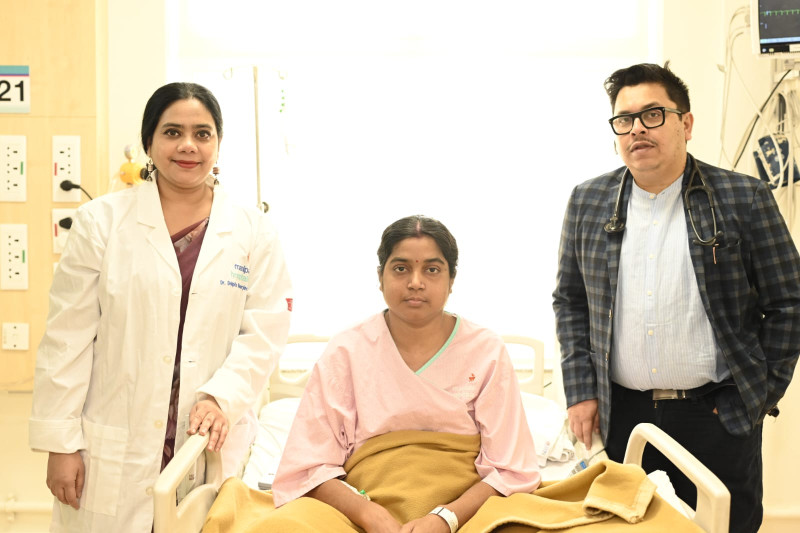
In a rare and highly complex medical success, a multidisciplinary team led by Dr. Upal Sengupta, Director – Team Nephrology & Consultant – Nephrology & Kidney Transplant, and Dr. Shilpita Banerjee, Consultant – Gynaecology, Obstetrics and Maternal Fetal Medicine at Manipal Hospital Mukundapur, a unit of one of India’s largest healthcare providers – Manipal Hospitals Group, successfully managed an extremely high-risk pregnancy in a renal transplant recipient, ensuring the safety of both mother and child while preserving graft function.
The patient, 33-year-old Madhabilata Kundu, a homemaker from Burdwan, had undergone a kidney transplant in December 2023. She presented at the hospital at 16 weeks of pregnancy while on long-term immunosuppressive therapy. With a medical history that included a previous caesarean section, a spontaneous miscarriage, hypertension, hypothyroidism, and the added risks associated with post-transplant pregnancy, the case required constant monitoring and meticulous clinical planning. Following extensive counselling and shared decision-making, the medical team decided to continue the pregnancy under strict multidisciplinary supervision involving specialists from Nephrology, Obstetrics, Anaesthesia, Critical Care and Neonatology.
At 21 weeks of gestation, the patient developed multiple serious complications, including suspected graft dysfunction, severe anaemia, rising creatinine levels, uncontrolled hypertension and active infections. She required urgent hospitalisation, blood transfusions, modification of immunosuppressive therapy and aggressive infection management. Throughout this critical phase, close fetal surveillance was conducted to ensure fetal well-being and to rule out abnormalities.
Despite stabilisation, by 28 weeks of pregnancy the patient showed worsening renal parameters, fluctuating blood pressure, intrauterine growth restriction and reduced amniotic fluid, raising serious concerns regarding maternal safety and graft preservation.
After detailed discussions among the Nephrology, Obstetrics, Anaesthesia and Neonatology teams, the decision was taken to proceed with an early planned caesarean section at 30 weeks and three days of gestation, in the best interest of the mother. With strong anaesthetic and neonatal support, the patient delivered a 1.6 kg baby girl who cried immediately after birth and was shifted to the Neonatal Intensive Care Unit (NICU), where she received specialised care for 20 days.
Explaining the obstetric challenges, Dr. Shilpita Banerjee said, “This pregnancy was medically fragile from the very beginning. The patient was battling multiple systemic complications, and even small clinical changes had the potential to significantly impact both maternal and fetal outcomes. Our responsibility was to carefully balance maternal stabilisation with continuous fetal monitoring. Coordinated teamwork and vigilant surveillance allowed us to safely prolong the pregnancy despite repeated challenges.”
Sharing the nephrology perspective, Dr. Upal Sengupta said, “Pregnancy following renal transplantation is inherently high-risk as it places additional physiological stress on the transplanted kidney. Our priority was to protect graft function while allowing the pregnancy to progress safely. This required continuous reassessment, careful adjustment of immunosuppressive therapy and avoidance of invasive procedures. The success of this case highlights the importance of timely decision-making and multidisciplinary coordination.”
Post-delivery, the mother experienced hypertension and urinary infection and required ICU support for three days. With timely medical intervention, her condition stabilised and renal parameters improved. She has since been discharged in stable condition. The baby has also been discharged and is doing well.
Expressing her gratitude, Madhabilata Kundu said, “There were moments when I feared losing my baby or harming my transplanted kidney. The doctors stood by me through every complication, explained every step and gave me confidence. Today, seeing my baby healthy feels nothing short of a miracle.”
Madhabilata’s husband, Tapas Kundu, who is employed in the private sector, supported her throughout the prolonged treatment and recovery.

