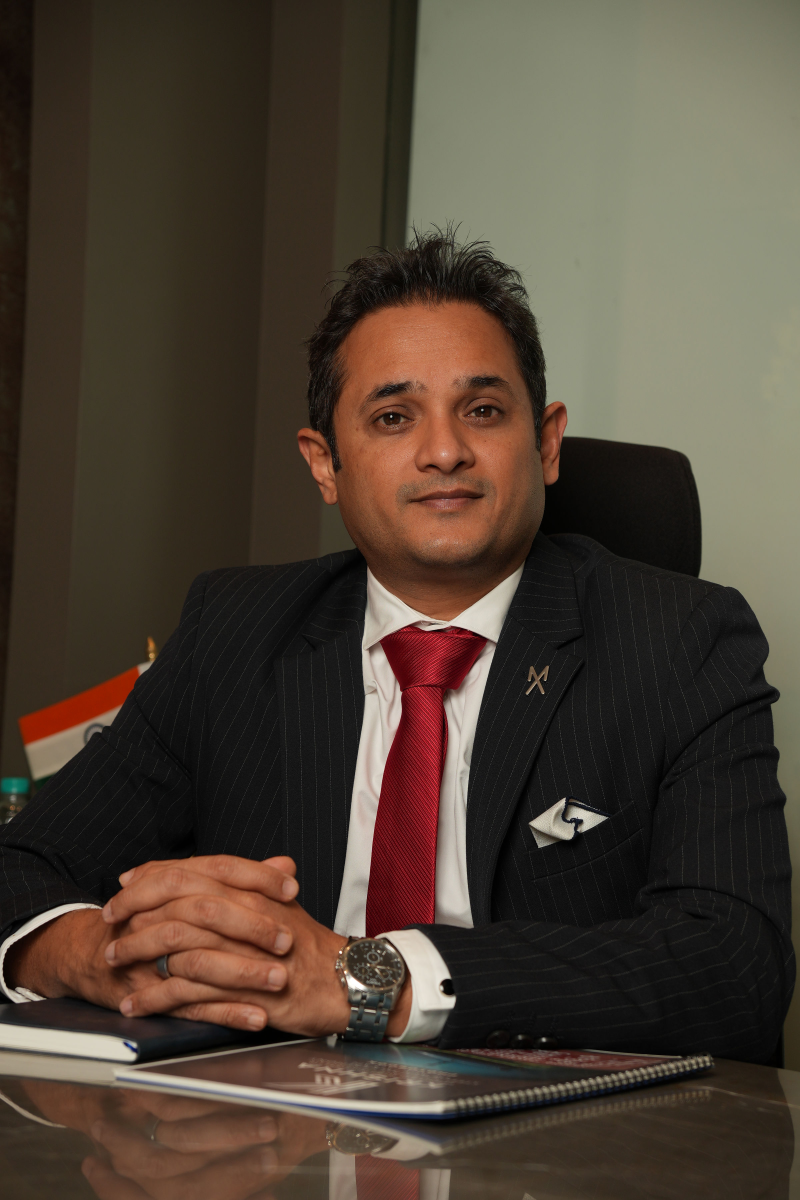
In conversation with Editor Ankur Sharma, The News Strike, Ankur Shah, Managing Director of Krishna Defence and Allied Industries Limited, said India’s defence indigenisation efforts must extend beyond final assembly to encompass critical sub-components, advanced materials, and resilient domestic supply chains. Citing India’s defence production crossing ₹1.54 lakh crore and exports reaching ₹38,424 crore in FY 2025–26, Shah highlighted the need for investments in advanced metallurgy, precision engineering, R&D, and deeper collaboration between industry, DRDO, defence PSUs, startups, and academia. He also outlined the company’s strategy to integrate into global defence supply chains through technology partnerships, compliance-driven manufacturing, AI-led design capabilities, and engagement with leading international defence contractors.
1. India’s defence push emphasises indigenisation—but how do you avoid becoming dependent on imported sub-components at critical layers?
India’s defence indigenisation journey cannot stop at final assembly; true self-reliance requires strengthening the entire supply chain ecosystem, especially at critical sub-component and material levels. India’s defence production has already crossed ₹1.54 lakh crore, while defence exports touched a record ₹38,424 crore in FY 2025–26, reflecting the rapid scale-up of the country’s indigenous manufacturing ecosystem. At Krishna Defence, our focus has been on making India self-reliant by developing innovative solutions while continuously reducing reliance on imports. Over the years, we have invested in advanced metallurgy, precision engineering, R&D, and indigenous manufacturing capabilities for strategic defence applications. Equally important is deeper collaboration between private industry, DRDO, defence PSUs, startups, and academia to build resilient domestic ecosystems.
2. Defence manufacturing globally is scale- and relationship-driven—what is your strategy to break into entrenched global supply chains?
Global defence manufacturing is built on long-term trust, technological reliability, and proven execution capabilities. At Krishna Defence, our strategy has been to steadily strengthen indigenous manufacturing, advanced metallurgy, and mission-critical engineering capabilities while aligning with global quality and compliance standards. We are actively establishing new associations with Tier-1 defence companies of the world and are making investments in technology collaborations, AI-led design simulations, and indigenously designed prototype systems. India’s growing focus on defence self-reliance, combined with the resilience of global supply chains, presents a favorable business environment for the Indian defence manufacturers.
3. How do you think about capital intensity versus innovation cycles in a sector where payback periods are long and uncertain?
We operate in defence with the mindset that high capital intensity and long, uncertain payback periods are a feature of the sector, not a bug, so we consciously separate “endurance capital” from “innovation capital” and design our portfolio accordingly. Instead of chasing every program, we direct heavy capex into platforms, processes and qualifications that will stay relevant across multiple tenders and product generations, and then layer faster innovation cycles through modular designs, incremental upgrades and digital engineering on top of that base to keep us agile without constantly retooling the balance sheet. We are disciplined about ensuring that each major capital outlay is underpinned by either recurring demand (spares, upgrades, lifecycle support) or by platform adjacencies so that the same asset can serve several customers and programs over time, which is critical in a business where individual program timelines can shift. At the same time, we view long-horizon R&D as a portfolio of options, balancing lower-risk near-term improvements with a few high-impact long-term bets. While returns may take a decade or more, we mitigate risk by strengthening underlying cash flows so the capital base continues to generate value even if innovation paybacks are delayed.
4. Is India building true IP ownership in defence, or largely assembling and integrating existing technologies? Where does KDAIL stand in that spectrum?
India is steadily moving beyond assembly-led manufacturing toward building indigenous intellectual property and strategic defence technologies, especially under initiatives like Make in India and Aatmanirbhar Bharat. The next phase of growth will depend on developing globally relevant IP backed by strong R&D, advanced engineering, and system-level design capabilities. At KDAIL, our focus is not limited to manufacturing alone. We are investing in indigenous prototyping, AI-led design simulations, specialised metallurgy, and mission-critical defence systems that strengthen sovereign capability. Projects like Autonomous Underwater Vehicle is an example of this evolution from product supplier to designer of innovative technology solutions. Our ultimate aim is to develop high-end indigenous technologies for use both within and outside India.
5. Given the dual-use nature of many technologies, how do you prioritise between defence and civilian verticals strategically?
At KDAIL, our strategic priority remains firmly aligned with strengthening India’s defence preparedness and supporting long-term self-reliance in critical technologies. However, many advanced capabilities such as metallurgy, precision engineering, AI-led design simulations, autonomous systems, and specialised materials naturally have dual-use applications across civilian industries as well. Our approach is to build core technologies and manufacturing capabilities that are defence-grade in reliability, compliance, and performance, while also identifying adjacent commercial opportunities where relevant. This allows us to enhance scalability, innovate faster, and be more resilient to technology disruptions. Most importantly, this leads to the creation of indigenous capabilities that will be prepared for the future, able to support our national and industrial needs.
6. How resilient is your order book to policy shifts or delays in government procurement cycles?
Our order book is structurally resilient to policy shifts and procurement cycle variability because it is anchored in long-term strategic priorities rather than short-term procurement events. The ongoing geopolitical environment has firmly accelerated India’s commitment to indigenisation through initiatives like Make in India and Aatmanirbhar Bharat, which are no longer policy experiments but embedded national imperatives. This creates a sustained demand baseline for domestic defence manufacturing. Within this context, we have deliberately built a diversified product portfolio aligned to critical and recurring requirements across platforms, ensuring continuity even when individual programs experience timing shifts. In addition to this, the positioning of our company in the supply chain is based on the necessary subsystems and technologies that have been mentioned above, which is inherently stable because of the constant existence of the demand for these subsystems and technologies throughout the purchasing process.
7. What would it take for an Indian private defence company to become globally competitive at the Tier-1 level—and what’s currently missing?
For an Indian private defence company to become globally competitive at the Tier-1 level, the focus must move beyond cost competitiveness toward technology ownership, precision manufacturing, reliability, and long-term strategic partnerships. India has made strong progress in defence indigenisation, with defence production reaching ₹1.27 lakh crore and the country emerging as one of the world’s fastest-growing defence manufacturing ecosystems. With India targeting ₹50,000 crore in defence exports and a domestic defence manufacturing ecosystem expected to reach around ₹3 lakh crore by 2029, the next phase will require deeper R&D investment, faster innovation cycles, stronger testing infrastructure, and greater integration into global supply chains. At KDAIL, we believe globally competitive defence manufacturing is built through consistent quality, metallurgical expertise, mission-ready engineering, and the ability to deliver at scale. The opportunity today is not just to manufacture in India, but to build globally trusted defence technologies and platforms from India.