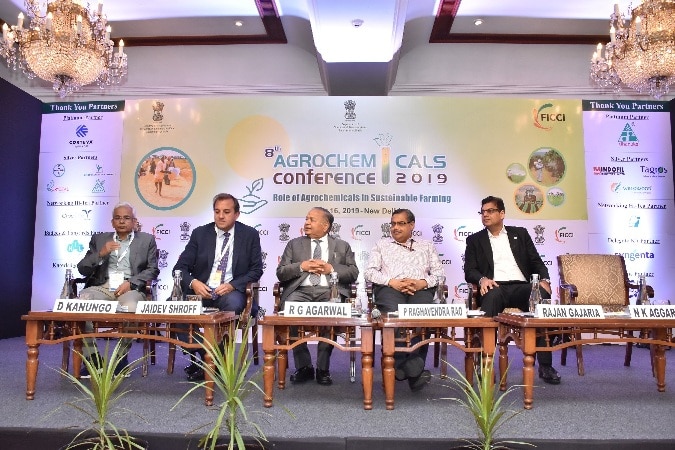
The Subcommittee on Agrochemicals of the Federation of Indian Chambers of Commerce and Industry (FICCI) today organised a conference on “Role of Agrochemicals in Sustainable Farming.” Shri P. Raghvendra Rao, Secretary (Chemicals & Petrochemicals), Department of Chemicals and Petrochemicals, Government of India, inaugurated the event. The conference was attended by senior officials, heads of agrochemical companies, scientists, academicians, technocrats, corporates, policymakers, and farmers. Prof. Ramesh Chand, Member, NITI Aayog, was also present.
Representatives from the agrochemical industry shared their perspectives on making agricultural practices in India more climate-resilient and profitable for farmers. Key topics discussed included reducing timelines for registration of new molecules (first-time-to-country), protection of regulatory data (PRD), and the implementation of international best practices. The participants also deliberated on enabling access to new technologies for Indian farmers, reducing GST on crop protection chemicals, and curbing the proliferation of spurious agrochemicals.
Shri R.G. Agarwal, Chairman, FICCI Subcommittee on Agrochemicals and Chairman, Dhanuka Agritech Ltd., said, “Crop protection is vital for ensuring better yields, which in turn lead to improved returns for farmers. While the government committee on ‘Doubling Farmers’ Income’ estimates agrochemicals account for merely 0.4% of the total cost of agriculture, the use of inferior or spurious pesticides can render the remaining 99.6% of investment ineffective. Therefore, ensuring the supply of quality pesticides to farmers must be a priority. Today’s discussions among industry stalwarts have generated valuable insights that will help bring the latest and best products to farmers.”
Mr. Rajan Gajaria, Executive Vice President, Business Platforms, Corteva Agriscience, said, “For the growth of this sector, we need to focus on building customer trust, converting technology into practical applications, and strengthening collaboration among stakeholders. Innovation is key to sustainable agriculture. As a leading global company, we can work with the government to bring the best technologies to India. By collaborating with the government, NGOs, industry peers, and even engaging with skeptics, we can ensure wider reach and development in the agriculture sector.”