

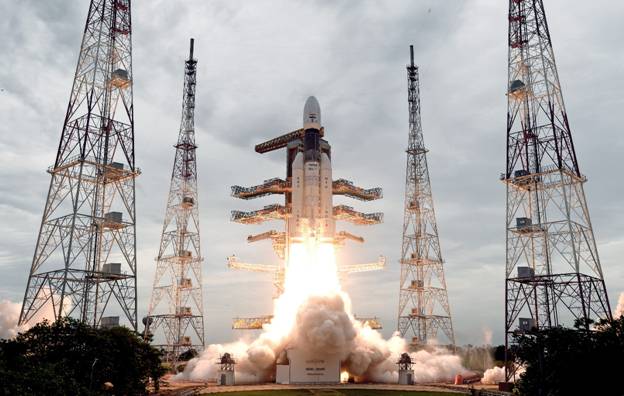
The 3,840-kg Chandrayaan-2 spacecraft was successfully injected into an Earth orbit with a perigee of 169.7 km and an apogee of 45,475 km. The mission marked the first operational flight of the GSLV Mk III launch vehicle.
After a countdown lasting nearly 20 hours, the rocket lifted off from the Second Launch Pad at 2:43 PM IST with the ignition of its twin S200 solid strap-on boosters. Approximately 16 minutes and 14 seconds after lift-off, the launch vehicle successfully placed Chandrayaan-2 into the designated orbit.
Soon after separation from the rocket, the spacecraft’s solar arrays deployed automatically, and mission control at the ISRO Telemetry Tracking and Command Network (ISTRAC) established communication and control over the spacecraft.
K. Sivan congratulated the scientists and engineers involved in the mission and described the launch as a historic moment for India’s space programme. He stated that the spacecraft had been placed into an orbit higher than originally planned, improving mission efficiency.
Chandrayaan-2 was designed as India’s second mission to the Moon and included an orbiter, the Vikram lander, and the Pragyan rover, all developed indigenously.

