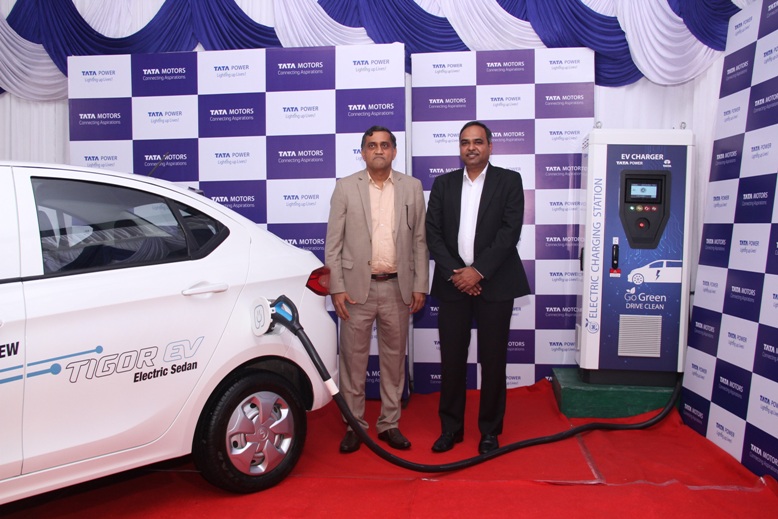
Tata Power and Tata Motors have partnered to establish 300 fast-charging stations across five major cities—Mumbai, Delhi, Pune, Bengaluru, and Hyderabad—by the end of FY20. As part of this initiative, the companies inaugurated their first seven charging stations in Pune, marking a significant step toward accelerating electric mobility in the country.
Over the following two months, an additional 45 charging stations were planned across the remaining four cities. The chargers are being installed at Tata Motors dealerships, select Tata Group retail outlets, and other public locations to enhance accessibility for electric vehicle (EV) users.
Operated by Tata Power, the initial 50 charging stations adhere to Bharat Standard (15 kW), with future installations planned under the 30–50 kW DC CCS2 standard. The charging infrastructure is accessible to all EV users whose vehicles are compatible with these standards. Tata Power and Tata Motors have also jointly developed a special charging tariff for Tata Motors EV customers.
Speaking on the partnership, Mr. Praveer Sinha, MD & CEO, Tata Power, said, “We are committed to making India EV-ready in line with the Government’s vision for green mobility and the Tata Group’s goal of reducing the country’s carbon footprint. Through this collaboration, we aim to make EV charging faster, easier, and more accessible for consumers.”
Mr. Guenter Butschek, CEO & MD, Tata Motors Ltd., added, “This partnership marks an important milestone in building a robust EV charging ecosystem in India. It supports our commitment to sustainable mobility and provides customers with greater confidence in adopting electric vehicles.”
At the time, Tata Power had established 42 charging points in Mumbai and a total of 85 charging points across cities including Hyderabad, Bengaluru, and Delhi. The company had also signed agreements with HPCL, IOCL, and IGL to set up EV charging stations at retail outlets and had previously partnered with Tata Motors to support the Maharashtra Government’s vision of promoting e-mobility through public charging infrastructure.