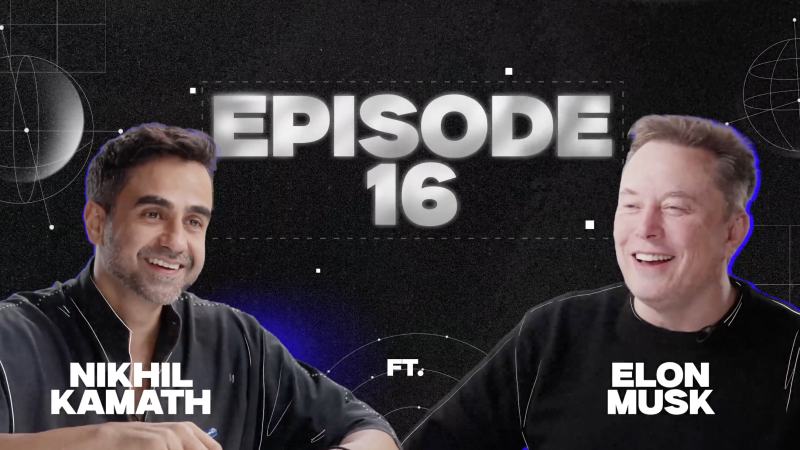
National, India, Sunday, November 30, 2025: In one of the most expansive and unexpectedly humorous conversations of the year, entrepreneur Nikhil Kamath sat down with Elon Musk for a marathon discussion spanning X (formerly Twitter), AI, the future of content, money energy, Starlink, friendship, tariffs, kids, DOGE, immigration, philanthropy and even whether live events are the world’s next big asset class.
Over two hours, Musk blends engineering detail, cosmic scale, deadpan humour, philosophical tangents, and human reflection into one of his most quotable, insight-packed dialogues. Key themes include:
1. X: Musk’s Global Brain: The conversation opens with Nikhil going straight for scale: “What percentage of the internet is spent on Twitter? Is there a number to it? On X?” Musk answers with crisp clarity, laying out the platform’s real footprint, “We have like about 600 million monthly users. It can get upto, 800 million or a billion if there's some major event in the world.” When Nikhil asks about the larger vision for X, Musk frames it as a global cognitive layer, something far beyond a traditional social network. He shares, “It would be great to bring together what people say in many different languages - automatically translated, so you have the collective consciousness not just of people in a particular language group, but every language group.”
2. Why Twitter? Nikhil brings up the elephant in the room, or in this case, the bird that became an X. He nudges Musk about one of his most controversial decisions: buying Twitter. Jokingly, he asks Musk, “I used to be a shareholder of X, a very small one. Happy decision? Glad you did it?”
Elon, in true Musk fashion, skips the PR gloss and dives straight into ideology. “I felt like Twitter had gone in a direction that had more of a negative influence on the world.” Musk explains that the takeover wasn’t a power move but more like a digital clean-up mission. “What I've tried to do is just restore it to be balanced and centrist. There haven't been any left-wing voices that have been suspended or banned or de-amplified or anything like that.” On the larger goal, Musk shares, “I just want to really have a global platform that becomes close to a collective consciousness of humanity as possible.”
3. AI + Video: Musk’s Next Evolution for X: Nikhil shifts the gear to the evolution of X in a world of changing media consumption. He asks, “How will X move as interaction shifts from text to new formats?” Elon predicts a transformative shift in how humans interact digitally, saying, “I do think most interaction is going to be video in the future… real-time video with AI… real-time video comprehension, real-time video generation.” Yet he underscores the continuing value of text explaining sharing, “Text tends to be higher value generally. It’s more densely compressed information.”
4. Reinventing Social Media From Scratch: Nikhil moves the conversation to first principles, asking Musk, “If one had to rework social media and build something bottom-up, what do you think would work for the world of tomorrow?” Elon starts by casually admitting he’s not sitting around brainstorming social-media hacks, “I don't think that much about social media, to be frank. I mostly just want to have something where there's, kind of a global town square where people can say what they want to say with words, pictures, video, where there's asecure messaging system.”
5. The Future Elon Musk is Most Excited About: Nikhil shifts the conversation toward ambition and aspiration, asking, “What's got you most excited now, Elon. Which one of all the products and services that you're building has got you most excited today??” Elon here shows his side as the visionary integrating space, renewable energy, and AI, highlighting, “I think that there's increasingly a convergence, actually, between SpaceX and Tesla and XAI in that if the future is solar-powered AI satellites. But all the companies are doing great things, very proud of the teams that do great work. So we're making great progress with Tesla on the autonomous driving.”
6. Starlink’s Physics-Defined Future in India: While discussing SpaceX, Elon shares, “SpaceX is doing great work with the Starlink program,providing low-cost, reliable internet throughout the world. We'dlove to be operating in India.” Nikhil probes Starlink’s urban potential in India’s connectivity landscape: “Starlink works differently than it might be in a place with not as many people. Can you explain how it works?” Elon clarifies that Starlink isn’t designed to replace urban networks but instead provides a transformative solution for remote regions, offering a lens to explore technology, policy, and social impact. He sets realistic expectations for rural deployment, highlighting, “It's not physically possible for Starlink to serve densely populated cities… maybe 1% or 2%… but it can be much more effective in rural areas.”
7. The Physics of Investing: Nikhil opens the conversation on predictability and markets, admitting the limits of forecasting: “There is no predictive value. Nobody knows what will happen tomorrow.” Elon reframes investing through first principles, applying this logic of Physics to markets. He explains, “If it's long-term for a company, do you like the products or services of that company? It seems like they make great products and they're likely to make great products in the future.” He extends the idea to the people behind the business: “You also want to believe in the team.” And he closes with clarity on what truly matters: “A company is just a group of people assembled to create products and services. If they’re likely to continue to improve, then you should buy the stock, and don’t worry too much about the daily fluctuations.”
8. Musk Predicts End of Work: Nikhil expands on Musk’s vision by noting how global shifts in labor, productivity, and AI are reshaping the very meaning and rhythm of work, He asks, “If we were to move from five to four to three days, how do you think society changes? When people have to work half the week, what do they do with the other half? ”
Elon predicts a dramatic transformation: “I think in the future it won't be the case that you have to be in a city for a job. My prediction is that in the future, working will be optional. Like a hobby,” He even offers a timeline: “People don't have to work at all.” He acknowledges that although AI may remove the necessity to work, but emphasizes, saying, “If you're trying to make a startup succeed or you're trying to make a company do very difficult things then you definitely need to put in serious hours.”
9. Musk’s Next Big Bet: When asked which company he would buy if he were a stock investor, Musk immediately separates himself from traditional investing: “I don’t really buy stocks. I’m not like an investor. I don’t have a portfolio or anything.” But pressed on where future value will come from, he shares: “AI and robotics are going to be very important.” He points to companies outside his own ecosystem that have laid the deepest foundations for the AI era, sharing, “I think Google is going to be pretty valuable in the future. They've laid the groundwork for an immense amount of value creation from an AI standpoint. NVIDIA is obvious at this point.”
The conversation then shifts to a surprising countertrend: the explosive growth of live events. Musk explains the underlying economics, “When digital media is ubiquitous, and you can just have anything digitally essentially for free. The scarce commodity will be live events. Because that will have more scarcity than anything digital.”
10. The Future of Money is Energy: In a thought-provoking segment, Nikhil asks Elon, “What do you think money will be in the future?” Musk responds with a sweeping prediction about the end of money, saying, “I think long term, I think money disappears as a concept. In a future where anyone can have anything. I think you no longer need money as a database for labor allocation.” He explains that automation will redefine scarcity itself: “If AI and robotics are big enough to satisfy all human needs, then money is no longer necessary.” Musk boldly predicts, “Energy is the true currency. I think that we probably won't have money, and probably we'll just have energy, power generation as the de facto currency.”
11. Musk on Tariffs: On the topic of tariffs, Musk makes a clear case, “I think generally free trade is more efficient. Tariffs tend to create distortions in markets.” When asked how the current political enthusiasm for tariffs might play out, Musk points directly to the President’s stance, saying, “The President has made it clear he loves tariffs.” Musk shares that although he has attempted to push back, he shares, “I’ve tried to dissuade him from this point of view, but unsuccessfully.”
12. AI: The Fix for U.S. Debt?: Nikhil raises a sharp geopolitical question, asking, “Is that the way forward for the U.S. by virtue of how much debt they have today? Do they deflate away their currency and transition into this new form and lead that push because it would make more sense to them?” Elon outlines a stark economic trajectory: “As long as civilization keeps advancing, we will have AI and robotics at a very large scale.” He directly connects this technological shift to America’s fiscal crisis, explaining, “I think that's pretty much the only thing that's going to solve for the U.S. debt crisis because currently the U.S. debt is insanely high and the interest payments on the debt exceed the entire military budget of the United States, just the interest payments.”
13. It’s best to avoid politics: The discussion then widens to the intersection of business and politics. Musk notes that founders don’t need politics to build something great until their company becomes too large to avoid it. He shares, “Not everything needs politics. Once you get to a certain scale, politics finds you. It’s quite unpleasant.” Additionally, Musk notes that founders don’t need politics to build something great, until their company becomes too large to avoid it, shares, “Not everything needs politics. Once you get to a certain scale, politics finds you. It’s quite unpleasant.”
When asked about his experience with politics, Musk answers with candor, “You know, I’ve generally found that when I get involved in politics, it ends up badly.” Asked whether this applies more broadly to business leaders, Musk agrees that the political arena is fundamentally hostile, sharing, “Politics is a blood sport. You enter politics, they’re going to go for the jugular. So best to avoid politics where possible.”
14. DOGE: Reflecting on what the Department of Government Efficiency (DOGE) experience taught him, Musk describes it as “a very interesting side quest” that unexpectedly opened a window into the inefficiencies of government. Through it, he discovered how deeply systemic the problems were. He shares, “There’s been quite a few efficiencies, some of them are very basic efficiencies.” Musk emphasizes that most of what DOGE implemented were simply “very common-sense things that would be normal for any organization that cared about financial responsibility.” And the work continues, “DOJ is still happening.”, Musk shares.
15. Immigration: The discussion turns to immigration, particularly the long-standing flow of Indian talent into the United States. Musk is unequivocal about its impact: “I think America has benefited immensely from talented Indians that have come to America.” But when asked why the climate around immigration appears to have shifted, Musk explains, “it was basically a total free-for-all with no border controls… unless you’ve got border controls, you’re not a country.” He says this produced “massive amounts of illegal immigration under the Biden administration,” and even a “negative selection effect,” where poorly designed incentives attracted the wrong kind of inflow. Meanwhile, on the right, there is “a perception that somehow their jobs are being taken by talented people from other countries.” Still, he acknowledges saying, “There has been some misuse of the H1B program. Some of the outsourcing companies have kind of gamed the system.” He supports fixing those abuses, but not dismantling the program: “We need to stop the gaming of the system… but I’m certainly not in the school of thought that we should shut down the H1B program.”
16. Message for Indian entrepreneurs: When asked to offer a message to India’s young entrepreneurs, Musk keeps his philosophy simple and universal: “I’m a big fan of anyone who wants to build. “I think anyone who wants to make more than they take has my respect.” while developing a mindset of creating more value than one consumes. He says, “Aim to make more than you take… be a net contributor to society.” He urges founders to resist chasing money directly, comparing it to the impossibility of chasing happiness itself. Musk also grounds his advice in realism: “Expect to grind super hard” and accept that “there’s some meaningful chance of failure.”
17. Why Elon likes the Letter X: Nikhil asks a pointed branding question that many people around the world have probably wondered about: “Why do you like the letter X as much as you do?”
Elon begins with humour: “It's a good question, honestly, sometimes I wonder what's wrong with me.” This leads him to his original vision for digital money. He explains, "I'm just kind of slowly building, revisiting this idea that I had 25 years ago to create a more efficient money database. He further shares that “Acquiring Twitter would also be an opportunity to revisit the original plan of X.com.” Musk connects this broader journey back to the name itself, saying, "I'd say is the idea for X anyway." It’s a theme that also appears in SpaceX’s branding, explaining, "so then space exploration technologies is the full name of the company - SpaceX like FedEx for space." The motif even shows up in his family life. Musk laughs as he says, “We got a kid, he's called X2.” And then he clarifies, "It's somewhat of a coincidence, you know, like not everything is called X, there's no X's in Tesla."
18. Philanthropy: When asked about his philosophy on philanthropy, Musk distinguishes sharply between the optics of generosity and the reality of making a genuine impact. “I agree with love of humanity, and I think we should try to do things that help our fellow human beings,”he says. Musk explains that he operates a large foundation but avoids attaching his name to its work: “I don’t put my name on it. I don’t want my name on anything.” He says, “The biggest challenge I find with my foundation is trying to give money away in a way that is truly beneficial to people.”
19. Elon’s Indian connection and view on children: Musk shares a personal connection to India through his partner: “My partner Siobhan, she’s half Indian.” He adds a detail about their family, “One of my sons with her… his middle name is Sekar after Chandra Sekar.” Regarding Siobhan’s ancestry, Musk explains, “She was given up for adoption. She grew up in Canada.”
When asked about his growing family, Musk jokes with characteristic humor, “I’m like an army. I'm trying to get an entire Roman Legion. On the topic of adoption, Musk is open but realistic, emphasizing his priorities: “I definitely have my hands full right now. I’m not opposed to it, but I do want to be able to spend some time with my kids, beyond a certain number, it’s kind of impossible.”
20. Musk on Friendship: While discussing friendship, Nikhil asks, "When you hang out with your friends, who are you?"
Elon initially jokes, asking, "Are you saying I have a friend? I wish I had friends." At a more personal level, Musk keeps it universal and grounded: “You want to have an emotional connection with other people.” For him, friendships aren’t engineered; they form naturally with “people you’ve resonated with on an emotional and intellectual level.” At the heart of it is his simple, time-tested definition of loyalty: “A friend is someone who’s going to support you in difficult times. Fair-weather friends are useless. And even with close friends, there are boundaries; some topics are simply off-limits. “We have come to the conclusion that we should not talk about AI or the simulation at parties… It’s kind of a buzzkill at times.”
Catch the full episode of 'People by WTF' featuring Elon Musk on here: Elon Musk: A Different Conversation | Full Episode | People by WTF Ep. 16
About the People by WTF podcast: People by WTF is a compelling series where Nikhil Kamath engages in candid, thought-provoking conversations with trailblazers from diverse industries across the globe. From business and technology to sports, entertainment, and policy, each episode offers rare insights into the minds of those redefining success. Through deep dives into pivotal moments, hard-earned lessons, and bold perspectives, People by WTF challenges conventional thinking and inspires audiences to push boundaries. This podcast is your gateway to transformative ideas, whether you're a business leader, entrepreneur, or someone eager to refine your skill set. Past guests include Indian Prime Minister Narendra Modi, Bill Gates, Nandan Nilekani, Ranbir Kapoor, and Kumar Mangalam Birla.