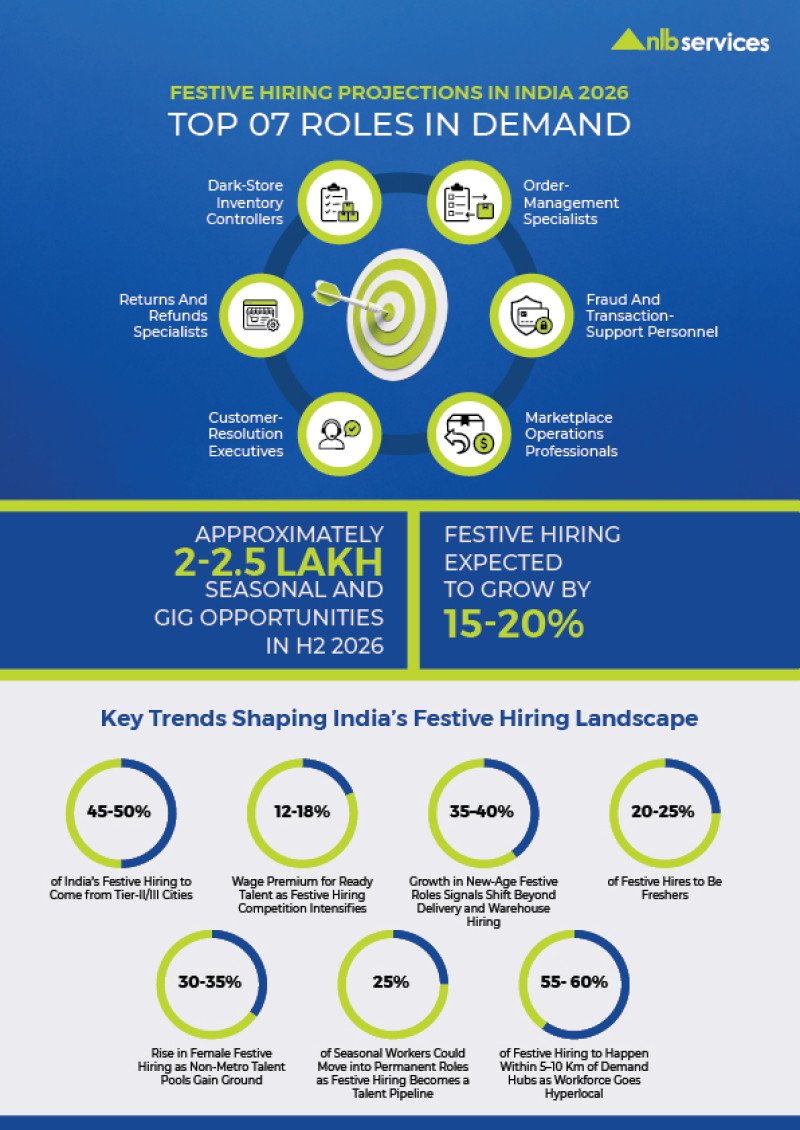
As India enters the festive season, businesses across e-commerce, quick commerce, retail, logistics, hospitality, travel and consumer services are preparing for one of the year'smost concentrated periods of demand. NLB Services expects festive hiring to grow by 15-20%, translating into approximately 2-2.5 lakh seasonal and gig opportunities in H2 2026.
However, the bigger story this year is not the number of jobs being created. It is how businesses are preparing for them. Festive hiring is increasingly moving from a last-minute,volume-driven exercise to a more structured and predictive workforce strategy-one that influences where companies hire, which skills they prioritise and how quickly talent needs to be deployed.
NLB Services is seeing employers begin workforce planning nearly 12-14 weeks ahead of the festive peak, allowing them to build talent pools earlier and reduce the pressure of compressedhiring cycles. As demand becomes increasingly concentrated into shorter windows, workforce readiness is emerging as a competitive advantage. The ability to identify, onboard and deploy talent quickly can directly influence fulfilment capacity, customer experienceand revenue during the peak season.
The composition of festive jobs is changing as well. While last-mile delivery, warehousing and fulfilment, retail sales, customer experience, inventory management, field operationsand hospitality will continue to account for a significant share of seasonal requirements, NLB Services expects 15-20% growth in new-age operational roles. These include dark-store inventory controllers, returns and refunds specialists, customer-resolutionexecutives, marketplace operations professionals, fraud and transaction-support personnel, catalogue management executives and order-management specialists.
This reflects a larger transformation underway in India's consumption economy- technology is moving deeper into frontline operations. Even roles traditionally considered operationalare becoming increasingly dependent on digital platforms, data, automation and real-time decision-making.
Festive hiring is also becoming more geographically distributed. Tier-II and Tier-III cities are expected to contribute around 45% of total festive hiring demand, with hiring inthese markets projected to grow 25-30%. The expansion of e-commerce, quick commerce, organised retail and regional fulfilment networks is driving demand across cities such as Jaipur, Lucknow, Indore, Surat, Nagpur, Bhubaneswar, Coimbatore, Chandigarh, andKochi.
This decentralisation is also creating a stronger role for hyperlocal talent pools. Businesses are increasingly looking to hire closer to retail stores, fulfilment centres, warehousesand delivery hubs, reducing deployment time while opening employment opportunities to workers who may not traditionally participate in peak-season hiring.
The festive workforce is also becoming more inclusive and geographically diverse. Freshers, first-time workers and women are emerging as an increasingly important talent pool, supportedby flexible shifts, proximity-based jobs and structured temporary employment. In several categories, women from non-metro locations are expected to account for 30-35% of new female hires, signalling that festive demand is opening up more employment opportunitiesbeyond traditional urban talent pools.