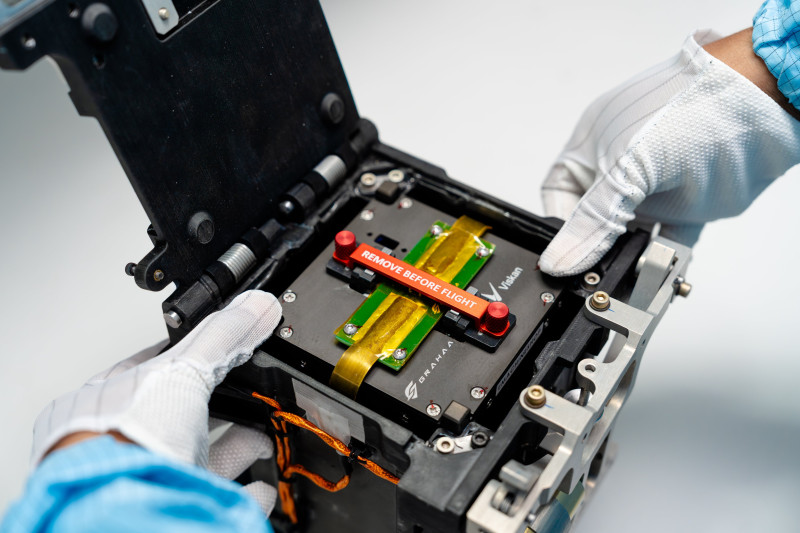
India, July 18, 2026: Grahaa Space, a spacetech company focused on developing Earth observation nanosatellites and geospatial intelligencesolutions, today announced the successful deployment of SOLARAS, its technology demonstration nanosatellite, aboard Skyroot Aerospace's Vikram-1 mission, launched from the Satish Dhawan Space Centre (SDSC), Sriharikota. The achievement marks a major milestone for the company, taking Grahaa Space one step closer to enabling faster, modular and cost-effective access to space.
The mission, named SIDDHI, marks an important milestone in Grahaa Space's journey to build indigenous, stackable nanosatellite platforms that can be customized for various low earth orbit (LEO) missions.Designed and developed in India, SOLARAS has been built to validate Grahaa Space's stackable nanosatellite bus and platform, communication systems and hosted payload architecture. The mission represents the company's first in-orbit technology demonstrationand lays the foundation for future Earth observation, commercial, scientific and institutional satellite missions.
The mission also carries VISWA-M, an academic research payload developed by VIT-AP University, Amaravati, showcasing the flexibility of Grahaa Space's hosted payload architecture in supporting academic,research and technology demonstration missions.
The company's long-term vision is to stream near-real-time geospatial video data that can be used for various on-ground missions.
Ramesh Kumar V, Co-founder & CEO, Grahaa Space, said: "Today is a defining moment for Grahaa Space. Watching SOLARAS successfully reach orbit is the culmination of years of engineering, perseverance and a shared vision of building world-class space technologies in India. This mission validates our indigenousnanosatellite platform and marks the beginning of an exciting new chapter for the company. We are grateful to Skyroot Aerospace for enabling this landmark mission and to our partners for their trust and collaboration. The success of SOLARAS strengthens ourcommitment to building scalable satellite platforms that make access to space faster, more affordable and more accessible for governments, enterprises, research institutions and the broader space ecosystem."
Following deployment, SOLARAS will undergo commissioning and in-orbit evaluation, during which Grahaa Space will assess the performance of its satellite platform and onboard systems. Insights from themission will support the company's future missions.
With SOLARAS now in orbit, Grahaa Space continues to advance its vision of enabling faster, flexible and application-led satellite missions while strengthening India's growing private space ecosystemthrough indigenous satellite technologies.