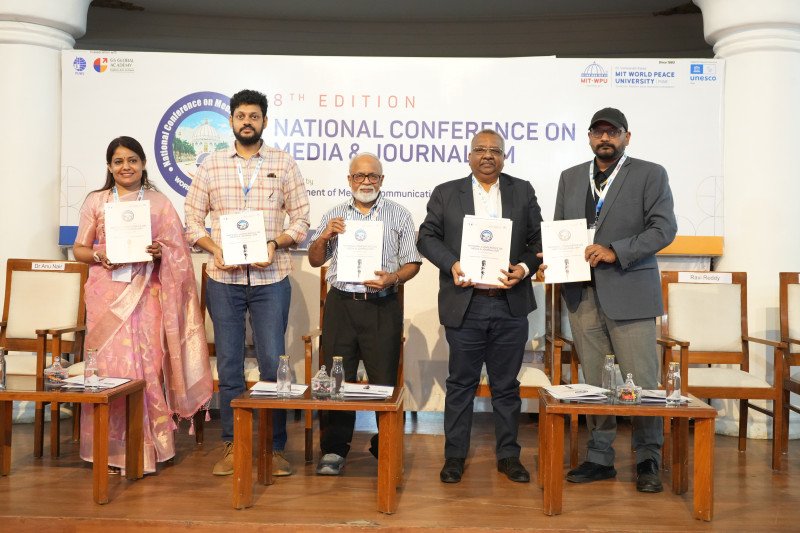
New Delhi, November 2, 2026: The growing influence of algorithms on news consumption, the real-world dangers of misinformation, and the challenge of preserving public trust in the age of AI emerged as key concerns at MIT World PeaceUniversity’s (MIT-WPU) 8th National Conference on Media and Journalism, held in Pune. Organised by the Department of Media & Communication around the theme “Dialogue, Inclusivity & Peace,” the two-day conference brought together senior editors, journalists, filmmakers, legal and policy experts, and advertising professionals to discuss the evolving responsibilities of media in a rapidly changing informationlandscape.
Welcoming the delegates at the inaugural session, the Vice Chancellor of MIT-WPU said the university is committed to experiential learning and curriculum innovation so that students are job-ready from day one. He added that the way journalistscommunicate matters, drawing on a verse from the Bhagavad Gita on speech that is truthful, pleasant and free of agitation.
“The responsibility now lies with the next generation to shape the future of media and journalism. Success isn't about publishing first—it is about validating truth, maintaining credibility, and delivering information that serves societymeaningfully.” Prof. Dr. Raviraja N. Seetharam, Vice Chancellor, MIT-WPU
Delivering the welcome address, Dr. Abhijit Nair, Dean of the School of Liberal Arts at MIT World Peace University, stressed the core focus of the conference, stating, 'The question before us today is no longer just how we reachpeople, but how we earn their trust through undivided, thoughtful attention.'"
The inaugural session, “The Attention Age: Media, Algorithms and the Battle for Trust,” was led by Chief Guest Ramesh Menon, author, award-winning journalist, documentary filmmaker and educator. He said shrinking attention spansand the rise of algorithms have changed who decides what people read. “The editor has changed. Today, who is the editor? The editor is an algorithm. And the algorithm does not ask you, ‘Is this true? Is this important?’ It has only one thing: ‘Will it hookthe reader?’” he said.
Ravi Reddy, Resident Editor, The Hindu, Hyderabad, said verification matters more than speed in an age of AI-generated content and deepfakes, and that AI can assist newsrooms but cannot replace human judgement. “Algorithms measureengagement. Journalism measures public value’ he said.
The valedictory session had theme, “Voices, Visions and the Future: Reshaping Media Discourses.” Chief Guest Dr Meena Sharma, Consulting Editor, News24, was joined by filmmaker Ashoke Viswanathan and Rajnandini Pawar, First Runner-Up,Femina Miss India. "The media today faces severe challenges regarding its credibility, and we must actively work to address them. There needs to be a conscious effort toward creating high-quality, impactful stories. Media students should take the leadby working on such stories—whether by pitching them to established outlets for publication or utilizing social media and digital platforms to reach the public directly." Dr Meena Sharma, Consulting Editor, News24
Sound designer and editor ASGK Teja described how conflicting claims on social media left him confused, and how he turned back to his daily newspaper for verified information. “When I took just five minutes to read the newspaper,I felt so happy. I was confident that I had received proper, verified information.”