From Sea to Space: A Research-Driven Work That Reframes India’s Defence Discourse
Reviewer: Vivek Shukla
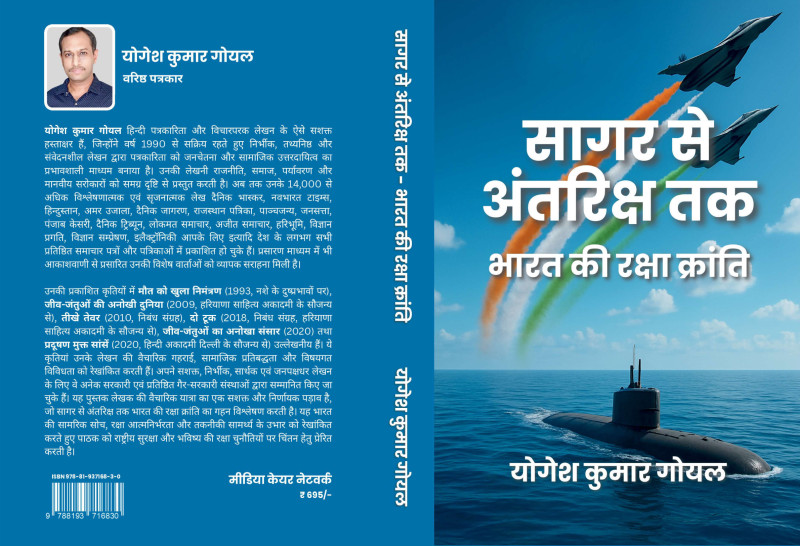
Book: From Sea to Space: India’s Defence Revolution
Author: Yogesh Kumar Goyal
Pages: 300
Price: ₹695
Publisher: Media Care Network, New Delhi
Defence and strategic studies are intrinsically linked to a nation’s security, sovereignty, and global standing. Books in this domain are not merely informational records; they carry national consciousness and help shape strategic thinking. When such discourse is presented in Hindi—a language with a vast and diverse readership—with seriousness, factual rigor, and a research-oriented lens, its significance multiplies. In this context, senior journalist and author Yogesh Kumar Goyal’s From Sea to Space: India’s Defence Revolution emerges as a timely and noteworthy contribution.
Supported by a publication grant from the Hindi Academy, Delhi, this is the author’s seventh book and gained attention around January 2026 as an important recent work. Spanning 300 pages, it presents an expansive narrative of independent India’s defence journey—from the depths of the seas to the heights of outer space—within a comprehensive strategic framework.
This book is not a mere catalogue of military hardware or technological milestones. Rather, it offers a structured analysis of the evolution of India’s strategic consciousness. The author carefully examines post-Independence defence policy, resource constraints, challenges in political–military coordination, and the hard-earned lessons from the wars of 1962, 1965, 1971, and Kargil. These conflicts compelled India to pursue self-reliance in defence production, technological upgradation, and mature strategic thinking. The book effectively connects this historical backdrop with contemporary defence reforms, illustrating how experience was transformed into capability.
One of the book’s major strengths lies in its depiction of modern India’s military capabilities. Developments in missile technology, air power, and air defence are discussed not only in technical terms but also through their strategic relevance. The narrative explains how precision-strike capabilities, credible nuclear deterrence, and layered air defence have reshaped India’s security posture. References to modern fighter aircraft and advanced defence systems underscore the emergence of a multi-layered and resilient defence architecture.
The author devotes special attention to naval modernisation. Amid growing geopolitical competition in the Indo-Pacific, aircraft carriers, advanced destroyers, submarines, and maritime surveillance systems have strengthened India’s maritime power. The book makes it clear that maritime security is no longer confined to coastal defence; it now encompasses global trade routes and strategic partnerships. In this context, India’s SAGAR vision and its proactive role in the Indo-Pacific are presented with balance and analytical clarity.
Perhaps the most compelling and distinctive section of the book is devoted to the space dimension. Warfare today is no longer limited to land, sea, and air; space has become the fourth domain of defence. The author provides a detailed account of the anti-satellite test “Mission Shakti,” conducted through collaboration between ISRO and DRDO, which placed India among the leading space-security-capable nations. By explaining the role of military satellites, secure communications, and surveillance networks, the book highlights how modern warfare has become information-centric, where data and monitoring are as critical as conventional weapons. This section also underscores India’s balanced deterrence posture in line with its “No First Use” doctrine.
The author’s journalistic background is clearly reflected in the language and presentation. Complex technical subjects are conveyed in a clear, fluent, and fact-rich style. Extensive use of verified data enhances the book’s credibility, while the accessible language makes it suitable even for general readers. Avoiding sensationalism common in defence writing, the author adopts a balanced and analytical approach, making the book worthy of serious study. References to contemporary operations and initiatives further strengthen its relevance, particularly in the context of the Atmanirbhar Bharat (self-reliant India) campaign.
The book’s assessment of the China–Pakistan nexus, border challenges, and strategic competition in the Indo-Pacific is measured and thoughtful. The author neither exaggerates threats nor underplays them; instead, he presents India’s preparedness and future possibilities through facts and strategic reasoning. This balance lends the work maturity and trustworthiness. By detailing initiatives such as Make in India, iDEX, defence public sector undertakings, and private-sector participation, the author demonstrates how India is transitioning from a major arms importer to an emerging force in defence production and exports.
For a long time, there has been a noticeable shortage of serious, research-driven defence literature in Hindi. Compared to the abundance of material available in English, such works in Hindi have been rare. From Sea to Space fills this critical gap. It is equally useful for students, defence studies researchers, journalists, policymakers, and informed citizens. The book strengthens awareness and pride in national security while conveying a clear message of preparedness for future challenges.
Overall, this work is not just an account of India’s military achievements; it is the story of a nation that, despite limited resources, multiple wars, and complex geopolitical realities, has remained committed to becoming strong and self-reliant. Through this book, Yogesh Kumar Goyal offers Hindi readers a comprehensive, balanced, and inspiring document of India’s defence journey. It celebrates present achievements while urging vigilance toward future challenges. In essence, From Sea to Space is not merely a book—it is a powerful mirror of national security consciousness, instilling confidence that India’s defence trajectory is steadily moving toward new heights.