

New Delhi, April 6, 2026
As part of the Distinguished Lecture Series, the Sarojini Naidu Centre for Women’s Studies hosted Prof Naila Kabeer, Professor Emeritus of Gender and Development at the Department of International Development, London School of Economics for a lecture titled Renegotiating Patriarchy, Gender Agency, and the Bangladesh Paradox. The session examined how Bangladesh achieved remarkable social progress despite economic challenges, focusing on women’s agency in reshaping patriarchal structures rather than dismantling them outright. Prof Kabeer explained that Bangladesh’s progress was both pro-poor and gender-equitable, driven by education policies, family planning initiatives, NGO interventions, and opportunities in the garment industry. She highlighted how women’s agency manifested in diverse forms, from hidden resistance to open bargaining and how these individual actions collectively scaled up to produce transformative social change.
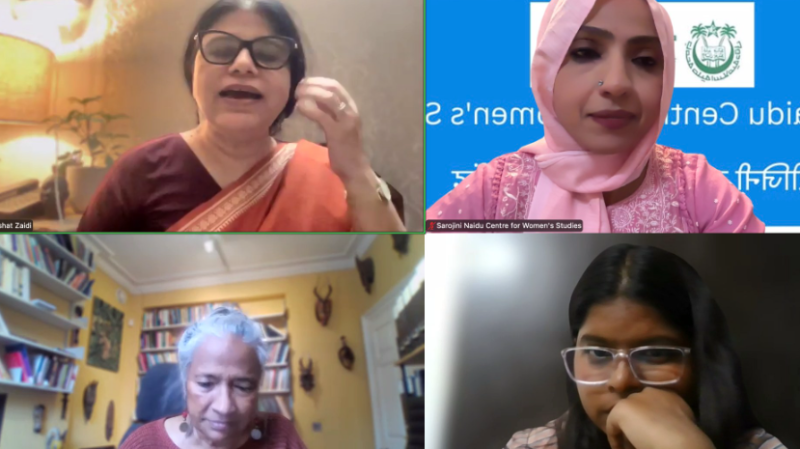
Preeti Maurya, PhD scholar at the centre opened the session followed by a welcome address and an introduction of the speaker by Prof. Nishat Zaidi, Honorary Director of the Sarojini Naidu Centre for Women’s Studies. Prof Kabeer discussed Bangladesh’s unique model of progress that diverges from Euro-American development patterns, emphasizing women’s agency and economic empowerment despite challenges such as labor exploitation in the garment industry. She addressed questions about the impact of Bangladesh’s female prime ministers, noting that while they provided important role models and implemented beneficial policies, they ultimately faced similar challenges of power politics. She also reflected on the 1971 war and the experiences of Biranganas, explaining how women realized the patriarchal bargain no longer held after men failed to protect them during the conflict. Highlighting the complexities of renegotiating patriarchal structures, she spoke about the “double bind” faced by women in the garment industry, where improved opportunities compared to agriculture or domestic work remained exploitative. She also addressed issues of domestic violence, the recognition of unpaid care work in GDP, and the impact of religious education on attitudes towards women’s roles and leadership.
Prof Kabeer presented her three-dimensional model of empowerment which is agency, resources, and achievements, explaining how education can transform individuals by increasing confidence and enabling independent decision-making. The discussion also touched on challenges posed by radical organizations with Prof Kabeer noting their attempts to appear more moderate for political gains. She compared Bangladesh’s Grameen Bank credit-based model with India’s self-help group model, noting that Grameen focused on poverty alleviation rather than social education.
The lecture was followed by a compelling Q/A sessions extending the discussion further from scholars and faculties alike. The lecture was well-attended by faculty and students from across India, reflecting Prof Kabeer’s popularity and the significance of the lecture series. Prof Kabeer concluded by noting that while Bangladesh continues to experience economic growth, challenges of inequality and governance persist. She expressed optimism about the potential for more inclusive policies under the new BNP leadership.

