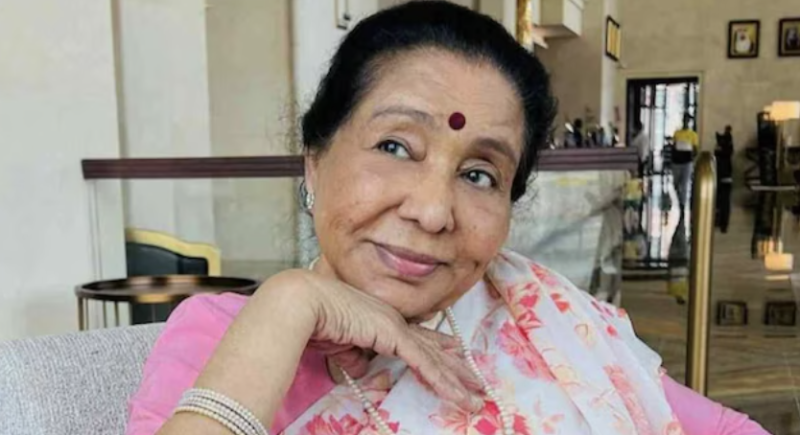
Mumbai/New Delhi, April 12: India bid farewell to one of its greatest musical legends on Sunday as Asha Bhosle passed away at Mumbai’s Breach Candy Hospital after a sudden deterioration in health. She had been admitted on Saturday following extreme exhaustion, chest infection, and respiratory complications, and doctors later confirmed multiple-organ failure as the cause of death.
Her son Anand Bhosle confirmed the news. The family said admirers can pay their final respects from 11 am on Monday at Casa Grande, Lower Parel, while the last rites will be held at 4 pm at Shivaji Park, Mumbai.
Born Asha Mangeshkar on September 8, 1933, in Goar near Sangli, she began singing as a child after the death of her father, classical vocalist and theatre personality Pandit Deenanath Mangeshkar. Alongside elder sister Lata Mangeshkar, she entered films at a young age to support the family, recording her first Marathi song in 1943 before making her Hindi playback debut in the late 1940s.
What followed was one of the most extraordinary careers in music history. Across 1943 to 2026, Asha Bhosle recorded more than 12,000 songs in over 20 languages, spanning Hindi, Marathi, Bengali, Gujarati, Punjabi, Tamil, Malayalam, English, and several global collaborations. Her command over genres—from filmi songs, ghazals, qawwalis, bhajans, folk, classical, Rabindra Sangeet, Nazrul Geeti, pop, disco, and cabaret—made her perhaps the most versatile playback singer Indian cinema has ever produced.
Her breakthrough came in the 1950s through landmark collaborations with O.P. Nayyar, especially Naya Daur, before redefining film music with composers such as S.D. Burman, Ravi, Khayyam, Jaidev, Shankar–Jaikishan, Madan Mohan, Bappi Lahiri, Ilaiyaraaja, Anu Malik, A.R. Rahman, and most memorably R.D. Burman, whom she later married.
Her voice gave Indian cinema some of its most immortal songs: “Piya Tu Ab To Aaja,” “Dum Maro Dum,” “Chura Liya Hai Tumne,” “Yeh Mera Dil,” “Dil Cheez Kya Hai,” “In Aankhon Ki Masti,” “Mera Kuch Saamaan,” “Tanha Tanha,” “Rangeela Re,” “Radha Kaise Na Jale,” and “Lucky Lips.”
Few singers reinvented themselves as fearlessly as Asha Bhosle. In the 1960s and 70s, she became the definitive voice for Helen’s dance numbers, adding sensuality and theatrical energy to Hindi cinema’s cabaret era. In the 1980s, she stunned purists with the delicate ghazals of Umrao Jaan, winning the National Film Award. In the 1990s and 2000s, she found renewed relevance with younger composers, from A.R. Rahman’s Rangeela to chartbusters in Lagaan and Pyaar Tune Kya Kiya.
Her achievements were equally monumental. She received the Dadasaheb Phalke Award (2000), Padma Vibhushan (2008), multiple National Film Awards, Filmfare Awards, Grammy nominations, Maharashtra Bhushan, and recognition from the Guinness Book of World Records as one of the most recorded artists in music history.
Beyond cinema, Bhosle constantly pushed artistic boundaries. She collaborated with international names including Boy George, Kronos Quartet, Sarah Brightman, Code Red, Michael Stipe, Brett Lee, and most recently featured on Gorillaz’s 2026 album The Mountain. Her influence also inspired global pop culture moments such as Cornershop’s international hit “Brimful of Asha.”
Away from music, she built a successful entrepreneurial identity through her global restaurant chain Asha’s, with outlets across Dubai, Kuwait, Doha, Bahrain, Abu Dhabi, and the UK—reflecting another side of her celebrated love for cooking and hospitality.
Her personal journey was as layered as her music—marked by early struggle, personal setbacks, reinvention, artistic daring, and late-career resurgence. Her marriage to R.D. Burman became one of Indian music’s most iconic creative partnerships, producing songs that remain evergreen across generations.
With Asha Bhosle’s passing, India loses not just a singer but an era-defining institution—a voice that moved effortlessly from heartbreak to seduction, devotion to rebellion, melody to modernity.
Yet her music remains immortal.
In every radio memory, wedding playlist, ghazal evening, retro countdown, and film archive, Asha Bhosle’s voice will continue to sing through India’s collective memory.