New Delhi: July 24, 2026
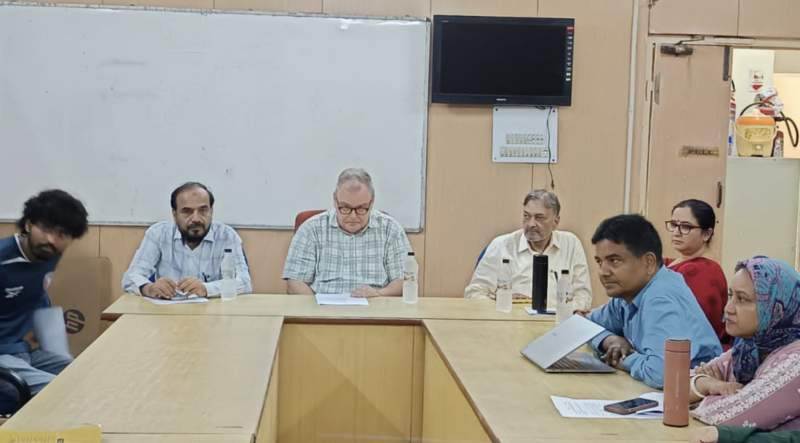
The Department of Educational Studies, Faculty of Education, Jamia Millia Islamia, through its Post-Graduate Education Association (PGEA) in collaboration with DES Theory-Practice Connect, organized a Lecture on the theme "Mother Tongue and English" on 23 July 2026 in the Seminar Hall, Department of Educational Studies.
The lecture aimed to provide students, research scholars, and faculty members with a deeper understanding of the relationship between mother tongue education and English language learning in multilingual societies and within the framework of contemporary educational policies. It also sought to promote meaningful academic dialogue on language, identity, equity, and educational opportunities in the Indian context.
The programme commenced with the recitation of the Holy Quran by Mr. Taj Mohammad, Research Scholar, followed by a warm welcome address delivered by Mr. Azhar Ahmad, M.Ed. student. In his welcome address, he highlighted the significance of the topic, which advocates the use of the mother tongue as the medium of instruction promoting multilingualism.
The keynote lecture was delivered by Professor Chaise LaDousa, Chair and Professor of Anthropology and Director of Educational Studies at Hamilton College, New York, USA. Professor LaDousa is an internationally acclaimed scholar whose research focuses on language, education, social class, and political economy, supported by extensive ethnographic fieldwork in North India.
In his highly engaging lecture, Professor LaDousa emphasized that language is much more than a medium of communication; it is closely connected with identity, culture, social mobility, and educational experiences. Drawing upon his long-term ethnographic research in India, he explained how the perceived divide between the mother tongue and English often reflects broader social aspirations and inequalities rather than linguistic realities. He argued that multilingualism should be viewed as an educational asset rather than a challenge and encouraged educators to create learning environments where students' home languages are respected and meaningfully integrated into classroom practices. His lecture stimulated thoughtful reflection on the role of language in promoting inclusive, equitable, and quality education.
The programme was further enriched by the Special Remarks delivered by Professor Arshad Ikram Ahmad, Former Head, Department of Educational Studies. Professor Ahmad highlighted the indispensable role of the mother tongue in cognitive development, conceptual understanding, and emotional growth. Referring to his extensive contributions to language education, multilingual instructional materials, and curriculum development, he emphasized the need to strengthen Indian languages while recognizing the country's rich linguistic diversity. He appreciated the relevance of the lecture and stressed the importance of implementing multilingual pedagogies in teacher education.
The session was chaired by Professor Aejaz Masih, Professor and Head, Department of Educational Studies. In his presidential remarks, Professor Masih appreciated the insightful deliberations and observed that language education should not be viewed as a competition between the mother tongue and English, but rather as a complementary process that enriches learners intellectually, socially, and culturally. Reflecting on India's linguistic diversity, he remarked that defining one's mother tongue is often a complex task in the Indian context. Drawing from his own experiences with Urdu and the influence of regional languages, he highlighted the dynamic and evolving nature of language.
The lecture witnessed enthusiastic participation from faculty members, research scholars, and students of the Department of Educational Studies and IASE. The interactive question-and-answer session reflected the participants' keen interest in issues related to multilingualism, the role of the mother tongue, regional languages, and language policy. Professor LaDousa responded to the questions with remarkable clarity and scholarly insight, making the interaction highly engaging and intellectually stimulating.
The programme concluded with a formal Vote of Thanks proposed by Dr. Afaque Nadeem Khan, Convenor of the programme. He expressed heartfelt gratitude to Professor Chaise LaDousa for his inspiring and thought-provoking lecture, Professor Aejaz Masih for graciously chairing the session and for his chair’s remark, and Professor Arshad Ikram Ahmad for his valuable insights and special remarks. He also acknowledged the support of the faculty members, students, and the organizing team. Special appreciation was extended to Dr. Md. Jawaid Hussain, Convenor of DES Theory-Practice Connect, whose meticulous planning and constant support contributed significantly to the successful organization of the programme. The programme was efficiently compered by Ms. Afrin Fatima and Mr. Azhar Ahmad.