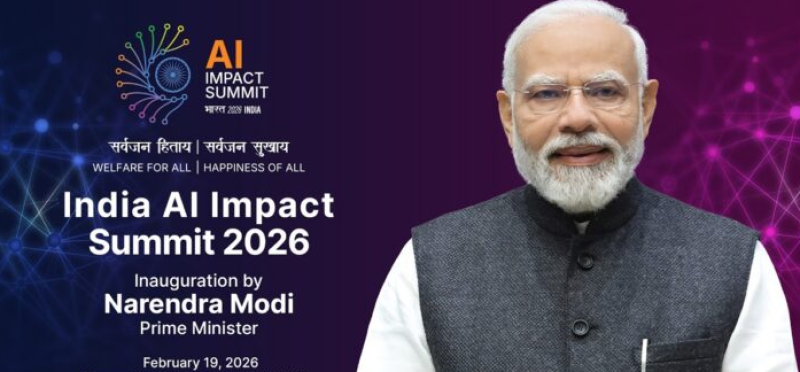
New Delhi | February 19, 2026 — Addressing world leaders, industry pioneers and innovators at the India AI Impact Summit 2026 in New Delhi, the Prime Minister outlined a comprehensive human-centric framework for Artificial Intelligence, positioning India at the forefront of ethical, inclusive and globally shared AI development.
Welcoming representatives from over 100 countries, the Prime Minister described the summit as historic, noting that it was being hosted in a nation representing one-sixth of humanity and home to the world’s largest youth population and one of the largest technology talent pools. He emphasized India’s dual strength in both developing and rapidly adopting emerging technologies.
Calling Artificial Intelligence a civilizational turning point comparable to the advent of writing or wireless communication, the Prime Minister said AI is not merely making machines intelligent but exponentially enhancing human capability. However, he stressed that the real question is not what AI can do in the future, but how humanity chooses to shape and govern it today.
Drawing a parallel with nuclear power—capable of both destruction and development—he underscored that AI must evolve from being machine-centric to human-centric, responsible and ethical.
The ‘MANAV’ Vision for AI
At the summit, the Prime Minister unveiled India’s AI framework titled MANAV, meaning “human.” The acronym outlines five foundational pillars:
M – Moral and Ethical Systems: AI must be built on clear ethical guidelines.
A – Accountable Governance: Transparent rules and robust oversight mechanisms.
N – National Sovereignty: Data ownership must rest with those who generate it.
A – Accessible and Inclusive: AI should act as a multiplier, not a monopoly.
V – Valid and Legitimate: AI systems must be lawful and verifiable.
He stated that this framework reflects India’s guiding philosophy of “Sarvajan Hitaya, Sarvajan Sukhaya” — welfare and happiness for all — ensuring that AI serves humanity rather than reducing individuals to mere data points.
Future of Work and Skilling
The Prime Minister highlighted that, much like the internet created industries and job categories unimaginable at its inception, AI will redefine the future of work. He described the coming era as one where humans and intelligent systems will “co-create, co-work, and co-evolve.”
He called for skilling, reskilling and lifelong learning to become a mass movement to ensure inclusive growth in an AI-driven economy.
Open AI and Global Standards
In a clear policy signal, the Prime Minister advocated for open collaboration over secrecy in AI development. While acknowledging that some countries view AI as a strategic asset to be developed confidentially, he argued that AI will benefit the world only when knowledge, code and innovation are shared openly.
He urged the global community to treat AI as a “Global Common Good.”
Addressing emerging risks, he called for international standards to counter deepfakes and fabricated content. Drawing an analogy to nutritional labels on food products, he proposed authenticity labeling and watermarking in the digital ecosystem to clearly identify AI-generated content.
He also stressed the importance of child safety in AI environments, advocating curated and family-guided digital ecosystems.
India’s AI Momentum
The Prime Minister concluded by asserting that India sees opportunity—not fear—in Artificial Intelligence. Highlighting the country’s talent base, energy capacity and policy clarity, he announced that three Indian companies launched new AI models and applications at the summit, showcasing the depth and diversity of India’s innovation ecosystem.
The India AI Impact Summit 2026 marks a significant milestone in shaping a collaborative, inclusive and human-centered global AI architecture.