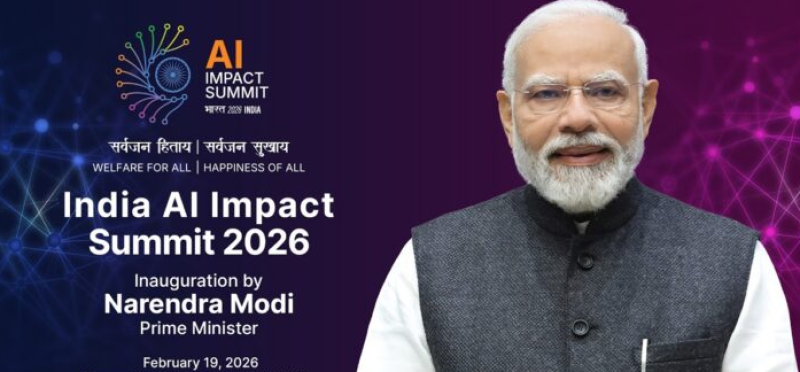
New Delhi | February 19, 2026 — A first-of-its-kind national repository mapping more than 110 AI-driven startups and non-profits working at population scale was unveiled at the India AI Impact Summit.
Titled “India’s AI Impact Startups”, the report has been jointly published by IndiaAI and Kalpa Impact. It documents organizations leveraging Artificial Intelligence to address large-scale social and economic challenges across healthcare, agriculture, education, climate action, financial inclusion, urban mobility, and public service delivery.
First Structured Map of Impact AI Ecosystem
The repository represents India’s first systematic mapping of its impact-oriented AI ecosystem. It highlights how Indian founders are building locally designed yet globally relevant AI solutions. The analysis reveals a dual trend of experimentation and consolidation within the ecosystem.
Voice AI and vernacular-language interfaces are emerging as primary tools to reach underserved populations, while a growing cohort of startups is investing in Made-in-India foundation models. The report positions itself as a reference resource for:
Policymakers seeking AI capabilities ready for integration with Digital Public Infrastructure
Investors identifying technically mature and scalable enterprises
The global development community looking for replicable Global South models
Government Perspective
Abhishek Singh, Additional Secretary, Ministry of Electronics and IT; Director General of NIC; and CEO of IndiaAI Mission, described the repository as a practical, unified reference that offers stakeholders a structured overview of AI initiatives aligned with public objectives. He noted that it showcases capabilities ready for integration, technological maturity, scalability, and long-term potential.
Mohammed Y. Safirulla K., IAS officer with the IndiaAI Mission, stated that India’s AI ecosystem is entering a decisive phase—transitioning from pilot projects to large-scale deployments serving millions. He emphasized the Mission’s commitment to nurturing this growth trajectory.
Anshul Singhal, GM (Startups), Ministry of Electronics and IT, highlighted the diversity of applications documented in the report—from court transcription tools and rural health screening solutions to AI-driven advisory services for smallholder farmers. He noted that Indian AI startups are not merely building applications but are creating inclusion-oriented infrastructure.
Industry View
Sushant Kumar, Founder and CEO of Kalpa Impact, described India’s AI ecosystem as focused on “super-utility”—deploying AI to solve real human and public service challenges. According to the analysis, many growth-stage firms have already expanded internationally, positioning India as a potential AI export hub for emerging economies.
From edge AI solutions that function without internet connectivity to voice bots operating in local dialects, Indian founders are building full-stack systems designed for the subcontinent’s unique challenges while maintaining global applicability.
The release of the repository at the India AI Impact Summit 2026 underscores India’s ambition to lead in inclusive, scalable and globally relevant AI innovation.