

Rural employment has been a cornerstone of India’s social security framework for nearly two decades. Since its implementation in 2005, the Mahatma Gandhi National Rural Employment Guarantee Act (MGNREGA) has played a critical role in providing wage employment, stabilising rural incomes, and creating basic infrastructure. However, over time, the socio-economic profile of rural India has changed significantly.
Rising incomes, improved connectivity, widespread digital access, and diversified livelihood options have altered the nature of rural employment needs. Against this backdrop, the President of India has given assent to the Viksit Bharat – Guarantee for Rural Employment and Livelihood Mission Act, 2025. This legislation represents a comprehensive statutory reform of MGNREGA, aligning rural employment with the long-term vision of Viksit Bharat 2047, while strengthening accountability, infrastructure outcomes, and income security.
Background: Rural Employment and Development Policy in India
Since Independence, India’s rural development policies have focused on poverty reduction, agricultural productivity, and employment generation for surplus and underemployed rural labour. Wage employment programmes gradually became a key instrument for rural support while simultaneously strengthening basic infrastructure.
Early initiatives such as the Rural Manpower Programme (1960s) and the Crash Scheme for Rural Employment (1971) laid the foundation. More structured efforts followed in the 1980s and 1990s, including the National Rural Employment Programme and the Rural Landless Employment Guarantee Programme, which later merged into the Jawahar Rozgar Yojana (1993). In 1999, these initiatives were consolidated into the Sampoorna Grameen Rozgar Yojana. Complementary schemes like the Employment Assurance Scheme and Food for Work addressed seasonal unemployment and food security.
A major shift occurred with the Maharashtra Employment Guarantee Act (1977), which introduced the concept of a legal right to work. These experiences culminated in the enactment of MGNREGA in 2005.
Evolution of MGNREGA and Limits of Incremental Reforms
MGNREGA aimed to enhance livelihood security by guaranteeing at least 100 days of unskilled wage employment annually to rural households willing to work. Over the years, several administrative and technological reforms strengthened implementation, improving participation, transparency, and digital governance.
Between FY 2013–14 and FY 2025–26:
Women’s participation increased from 48% to 58.15%
Aadhaar seeding and Aadhaar-based payment systems expanded significantly
Electronic wage payments became nearly universal
Geo-tagged assets and worksite monitoring improved substantially
The programme highlighted the crucial role of frontline workers, who ensured continuity despite limited administrative resources. However, persistent structural challenges remained. Field reviews revealed mismatches between expenditure and actual work, misuse of machinery in labour-intensive works, repeated violations of digital attendance systems, and limited completion of the full 100 days of employment by households, especially in the post-pandemic period.
These trends indicated that while delivery systems improved, the overall framework had reached its limits.
The Viksit Bharat – GRAMJEE Act, 2025 addresses these issues through a comprehensive legal restructuring. It increases the administrative expenditure ceiling from 6% to 9%, enabling better staffing, training, remuneration, and technical capacity. This shift supports a more professional, people-centric implementation system, improving planning, service delivery, and accountability at the grassroots level.
Rationale for a New Statutory Framework
The need for reform is also driven by major socio-economic changes. When MGNREGA was launched in 2005, rural India faced widespread poverty. By contrast, poverty levels declined from 27.1% in 2011–12 to 5.3% in 2022–23, supported by higher consumption, improved financial inclusion, and expanded welfare coverage.
With increasingly diversified and digitally integrated rural livelihoods, MGNREGA’s earlier demand-driven structure no longer fully reflected ground realities.
The Viksit Bharat – GRAMJEE Act, 2025 responds by modernising rural employment guarantees, strengthening accountability, and aligning job creation with long-term infrastructure and climate-resilience objectives.
Key Features of the Viksit Bharat – GRAMJEE Act, 2025
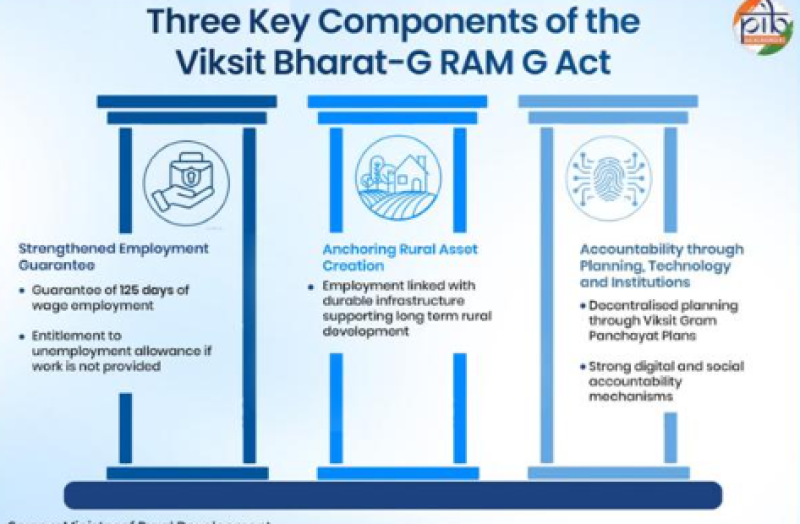
125 days of guaranteed wage employment per financial year for eligible rural households, up from 100 days.
A 60-day no-work period during peak agricultural sowing and harvesting seasons to ensure labour availability for farming.
Guaranteed employment during the remaining 305 days of the year, benefiting both farmers and workers.
Timely wage payments, weekly or within 15 days of work completion.
Employment generation is linked to infrastructure development across four priority sectors:
Water security through water-related works
Core rural infrastructure
Livelihood-linked infrastructure
Climate resilience and mitigation works
All assets created are integrated into the Viksit Bharat National Rural Infrastructure Framework, ensuring alignment with national systems such as PM Gati Shakti. Planning is decentralised through Viksit Gram Panchayat Plans, prepared locally and integrated digitally with national platforms.
Financial Framework
The shift from a fully central scheme to a centrally sponsored framework reflects the localised nature of rural employment and asset creation.
Total estimated annual requirement: ₹1,51,282 crore (including state share)
Estimated central share: ₹95,692.31 crore
Cost-sharing pattern:
60:40 between Centre and States
90:10 for North-Eastern and Himalayan states
100% central funding for Union Territories without legislatures
Additional provisions include disaster-related support, enhanced monitoring mechanisms, and fiscal safeguards to prevent misuse while ensuring stability.
Implementation and Monitoring Structure
The Act establishes a multi-tier institutional framework at national, state, district, block, and village levels.
Central and State Rural Employment Guarantee Councils provide policy direction and oversight.
National and State Steering Committees guide strategy and review performance.
Panchayati Raj Institutions lead planning and execution, with Gram Panchayats implementing at least 50% of works.
District Programme Coordinators and Programme Officers manage compliance, payments, and social audits.
Gram Sabhas conduct mandatory social audits and ensure transparency.
Transparency, Accountability, and Social Security
The Act empowers the central government with clear enforcement authority to investigate complaints, suspend fund releases in case of serious irregularities, and mandate corrective actions.
A comprehensive transparency framework covers all stages of implementation:
Use of AI and biometric authentication for early detection of irregularities
GPS- and mobile-based real-time monitoring of works
Public MIS dashboards and weekly disclosures
Mandatory social audits at least once every six months
Workers are entitled to unemployment allowance if work is not provided within 15 days, with responsibility assigned to states. Wage rates and conditions will be prescribed through rules to ensure flexibility while safeguarding workers’ rights.

